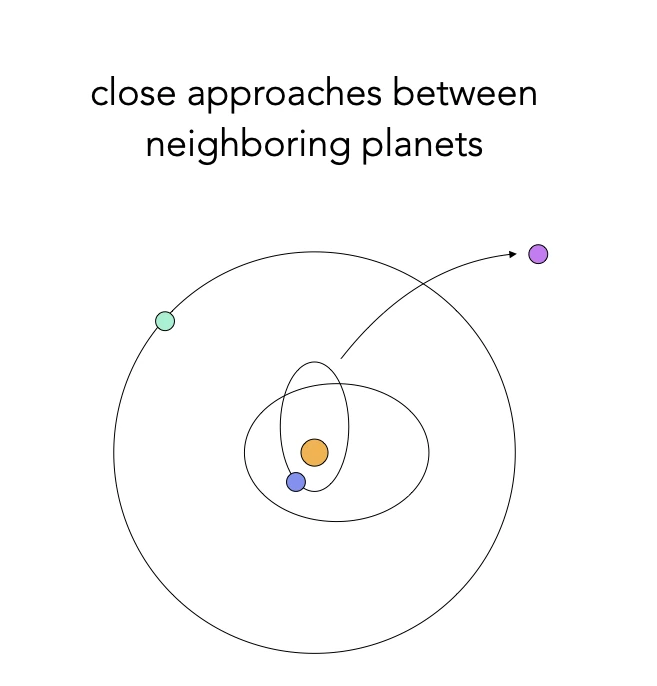
A close encounter gives one planet enough speed to escape. Rice, DeRocco, and Raymond, Fig. 1 (detail)
2026 · Planet formation
How does a planet lose its star?
Many planets may have been kicked out of the systems in which they formed. In this review, we looked at the many processes that can lead to this and what they might tell us about the origin of rogue planets.
The Dynamics of Planetary Ejection Malena Rice, William DeRocco, and Sean N. Raymond Publications of the Astronomical Society of the Pacific 138, 082001 (2026)
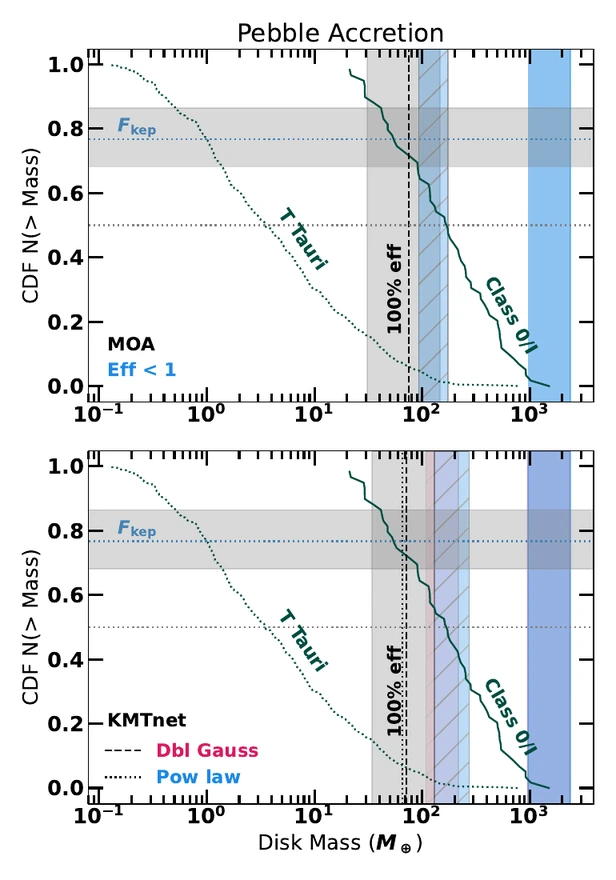
The curves show the fraction of disks above each mass. The vertical bands mark how much material planet formation would require. Lee et al., Fig. 2 (left panels)
2026 · Planet formation
Where did young stars find enough material to make all these planets?
If small rogue planets are as common as some surveys suggest, typical disks around young stars contain too little solid material to build them and the planets that stay behind. Measurements of the lightest rogue planets could tell us how much material we need to account for.
The Persistent Missing Mass Problem in Planet Formation Eve J. Lee, William DeRocco, Sam Hadden, and B. Scott Gaudi The Astrophysical Journal Letters 1005, L18 (2026)
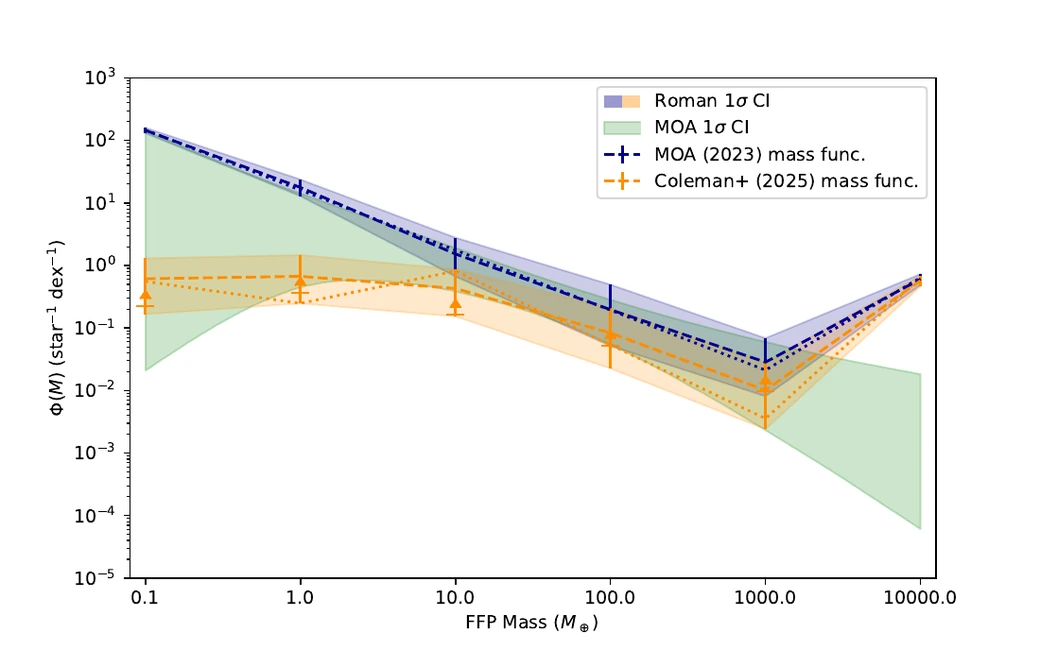
Two models predict different numbers of low-mass planets. The narrow bands show how precisely Roman could distinguish them. DeRocco et al., Fig. 4
2026 · Rogue planets
How common are rogue planets lighter than Earth?
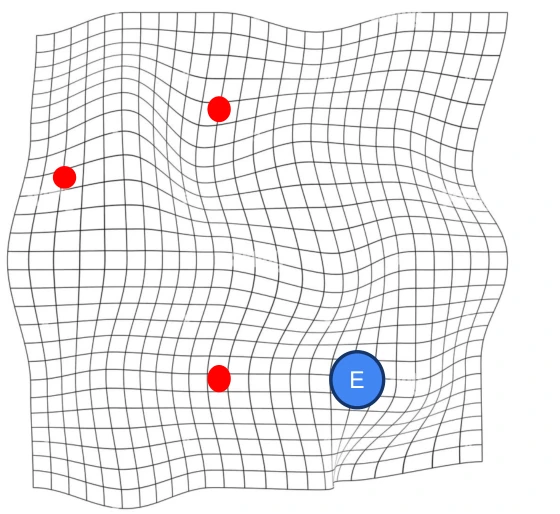
A rogue planet can briefly brighten a background star as its gravity bends the passing light. The Roman Space Telescope presents an opportunity to use these rare events to determine how many free-floating planets truly exist, and potentially, where they came from.
Prospects for Reconstructing the Free-floating Planet Mass Function at the Population Level with the Nancy Grace Roman Space Telescope William DeRocco, Samson A. Johnson, Farzaneh Zohrabi, Matthew T. Penny, and Peter McGill The Astronomical Journal 172, 7 (2026)
A passing wave changes the timing of pulses traveling from the red pulsars to Earth. Zheng et al., Fig. 1 (detail)
2026 · Gravitational waves · Collaborative research
Can we hear a gravitational wave that takes centuries to pass?
A gravitational wave can change the apparent ticking of pulsars even when a single cycle lasts far longer than our observations. We searched for that slow drift and found no signal, improving the sensitivity to these waves by about a factor of ten.
Probing picohertz gravitational waves with pulsars Qinyuan Zheng, Chiara M. F. Mingarelli, William DeRocco, Jonathan Nay, Kimberly K. Boddy, and Jeff A. Dror Physical Review D 113, 023037 (2026)
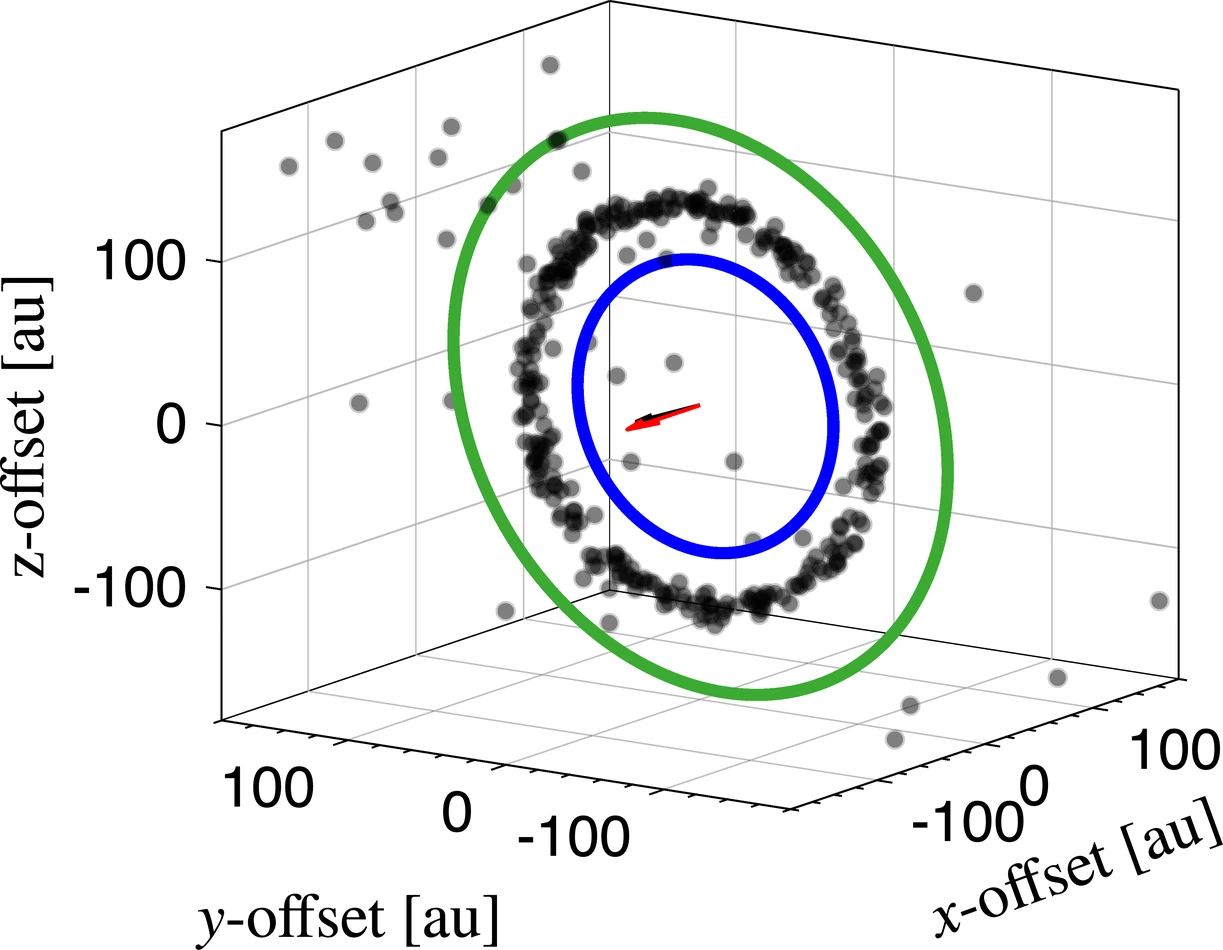
In the simulation, the blue and green planetary orbits bracket the debris ring. Smallwood et al., Fig. 5
2026 · Circumbinary planets
What keeps the debris ring around 99 Herculis so narrow?
A narrow belt of debris circles this pair of stars nearly at right angles to their orbit. In our simulations, two unseen planets could keep the belt in shape, one clearing its inner edge and the other clearing its outer edge.
The polar debris disc around 99 Herculis: a potential signpost for polar circumbinary planets Jeremy L. Smallwood, William DeRocco, Zhizhen Qin, and Antranik A. Sefilian Monthly Notices of the Royal Astronomical Society 545, staf1982 (2026)
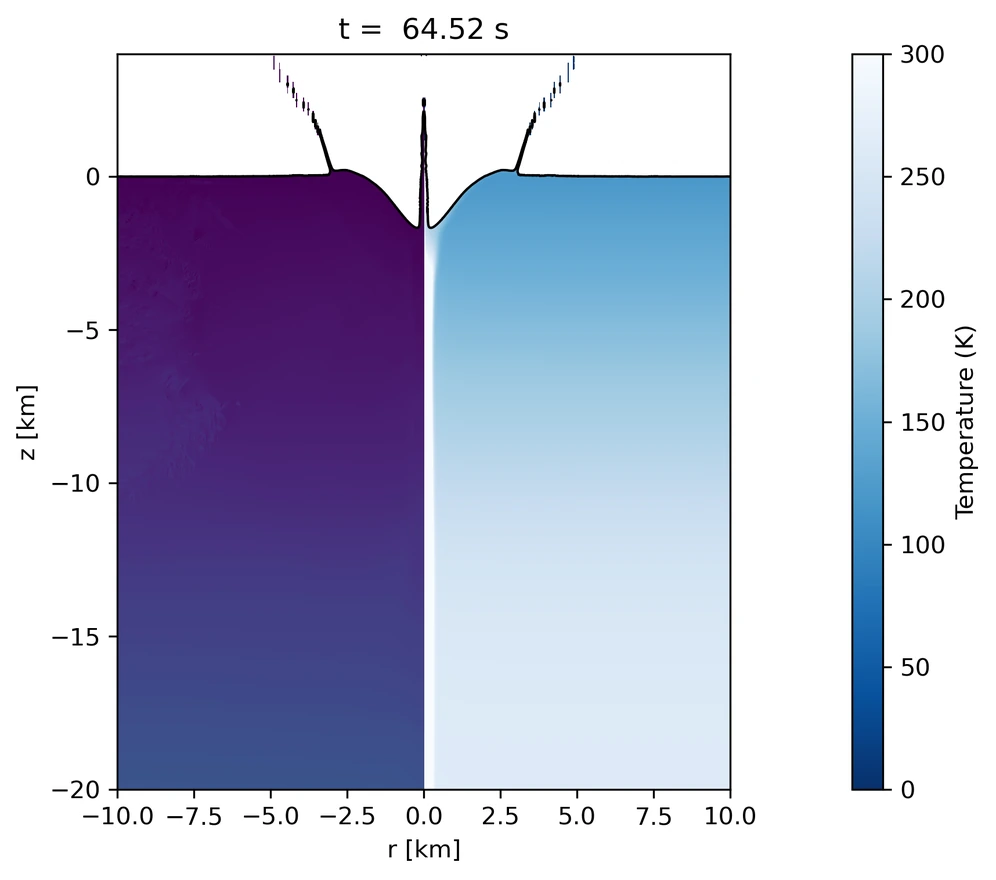
About a minute after the simulated impact, material from below the ice reaches the surface. DeRocco, Fig. 3 (detail)
2025 · Dark matter
Could dark matter leave a scar on Ganymede?
I simulated what would happen if a dense clump of dark matter struck Jupiter’s largest moon. The impact could punch through its ice and bring buried material to the surface, leaving a chemical signature upcoming missions could look for.
Ganymede’s subsurface ocean as a dark matter detector William DeRocco Physical Review D 112, 115023 (2025)
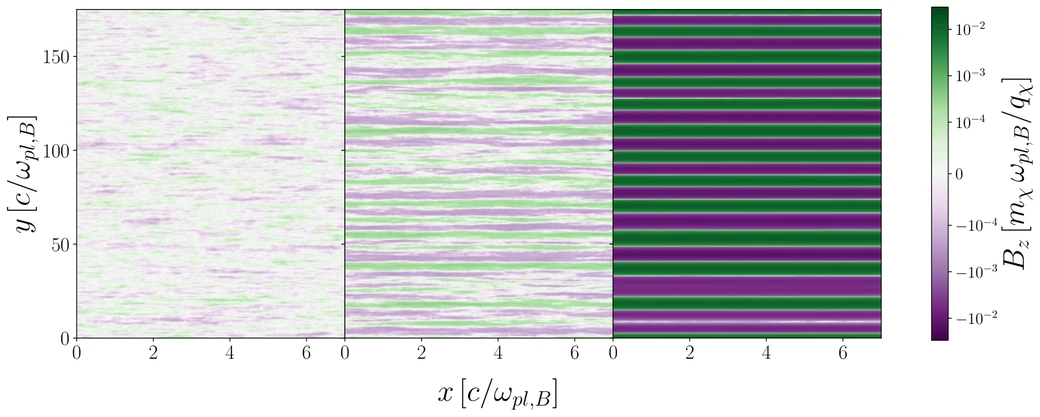
From left to right, a magnetic field develops as two simulated streams of dark matter pass through each other. DeRocco & Giffin, Fig. 10
2025 · Dark matter
What if dark matter behaved like a plasma?
If dark matter carries its own kind of electric charge, two colliding streams can generate fields strong enough to deflect the particles. We simulated those fields and used the observed Bullet Cluster collision to tighten the limit on how much dark charge each particle could carry for its mass.
Dark plasmas in the nonlinear regime: Constraints from particle-in-cell simulations William DeRocco and Pierce Giffin Physical Review D 111, 095031 (2025)
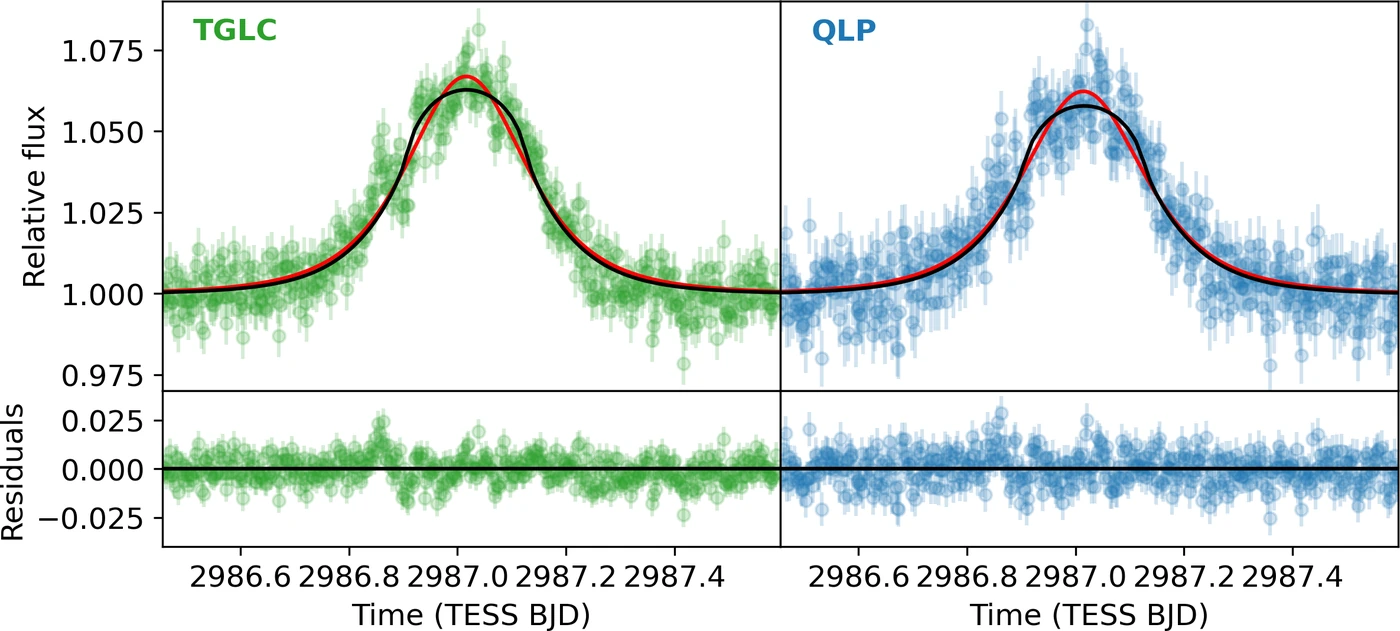
Two ways of measuring the starlight recover the same brightening. The overlaid curves show how a gravitational lens would brighten the star. Kunimoto et al., Fig. 9
2025 · Rogue planets
Can TESS catch a planet drifting across our line of sight?
We searched 7.5 million stellar brightness records for the brief brightening that occurs when a rogue planet bends a star’s light. One event had the right shape, but activity on the star itself provides an alternate explanation.
Searching for Free-floating Planets with TESS: Results from Sectors 61–65 Michelle Kunimoto, William DeRocco, Nolan Smyth, Steve Bryson, and B. Scott Gaudi (Kunimoto and DeRocco share first authorship) The Astronomical Journal 170, 321 (2025)
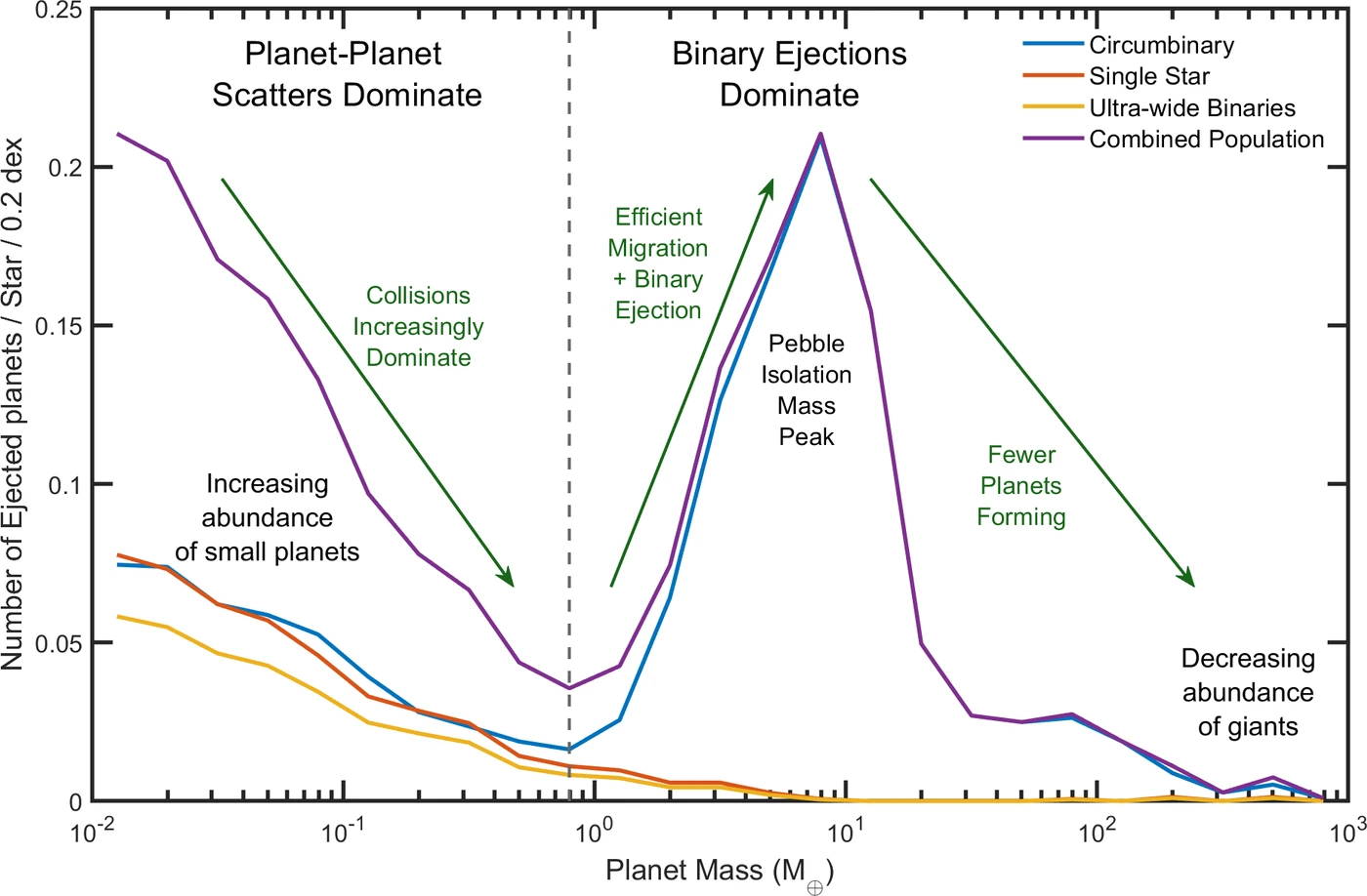
The curves count ejected planets by mass. The predicted peak near eight Earth masses comes mainly from close binary stars. Coleman & DeRocco, Fig. 2
2025 · Planet formation
Which star systems eject the most rogue planets?
In simulations of planet formation around binary stars, we found that close binaries can efficiently eject planets above an Earth mass. These worlds may dominate the population of free-floating planets.
Predicting the Galactic population of free-floating planets from realistic initial conditions Gavin A. L. Coleman and William DeRocco (shared first authorship) Monthly Notices of the Royal Astronomical Society 537, 2303–2312 (2025)
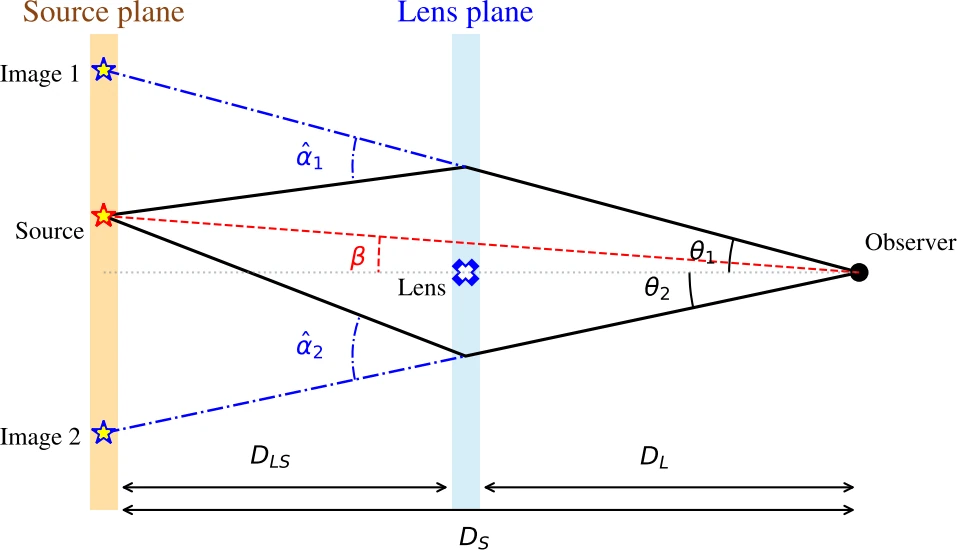
Light takes different times to follow the two paths around the intervening mass. Their arrival-time difference carries information about the lens. Liu et al., Fig. 1
2025 · Gravitational lensing
Can quantum mechanics help us measure the mass of lonely planets?
Gravity can split starlight onto paths that take slightly different times to reach Earth. We developed a way of using quantum algorithms to extract that delay using far fewer photons than earlier proposals, potentially allowing astronomers to weigh a lens even when the telescope sees only a single point of light.
Measuring gravitational lensing time delays with quantum information processing Zhenning Liu, William DeRocco, Shiming Gu, Emil T. Khabiboulline, Soonwon Choi, Andrew M. Childs, Anson Hook, Alexey V. Gorshkov, and Daniel Gottesman Preprint · arXiv:2510.07898 (2025)
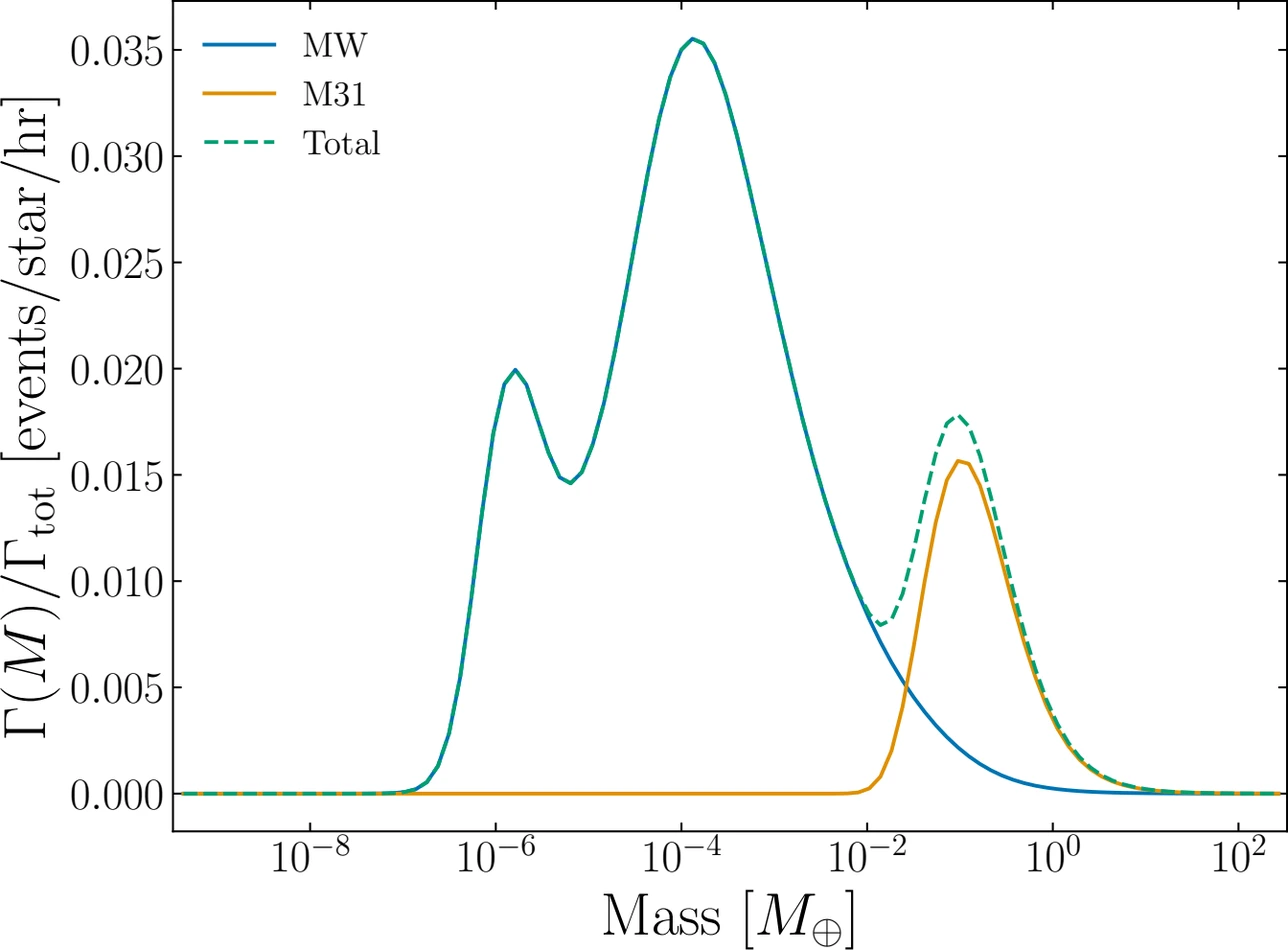
The blue and orange curves show which masses were easiest to spot in the Milky Way and Andromeda, respectively. DeRocco, Smyth, and Profumo, Fig. 2
2024 · Rogue planets
How small a rogue world could Subaru detect?
Using rapid observations of stars in Andromeda, we placed limits on the number of small worlds wandering through space. For objects in our own galaxy along that line of sight, the survey was most sensitive to masses around one ten-thousandth of Earth’s.
Constraints on sub-terrestrial free-floating planets from Subaru microlensing observations William DeRocco, Nolan Smyth, and Stefano Profumo Monthly Notices of the Royal Astronomical Society 527, 8921–8930 (2024)
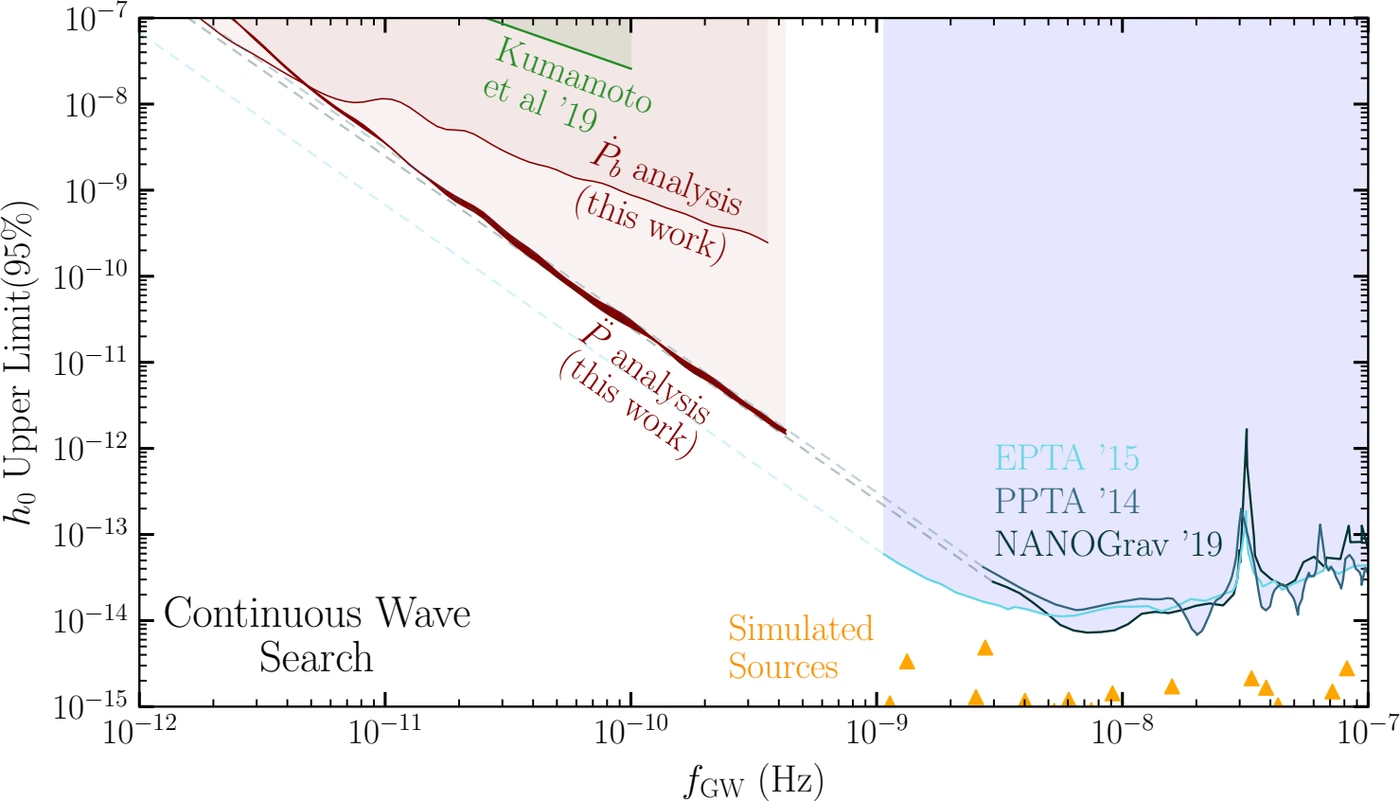
The red curves show the strongest waves compatible with the pulsar data, extending the search to periods longer than the observations. DeRocco & Dror, Fig. 1
2024 · Gravitational waves
Could we detect a single gravitational wave before it completes a cycle?
A passing gravitational wave slowly shifts the apparent ticking of pulsars and the orbits of their companions. We used those drifts to search for a wave from an individual pair of supermassive black holes. The data set an upper limit on its strength.
Using Pulsar Parameter Drifts to Detect Subnanohertz Gravitational Waves William DeRocco and Jeff A. Dror Physical Review Letters 132, 101403 (2024)
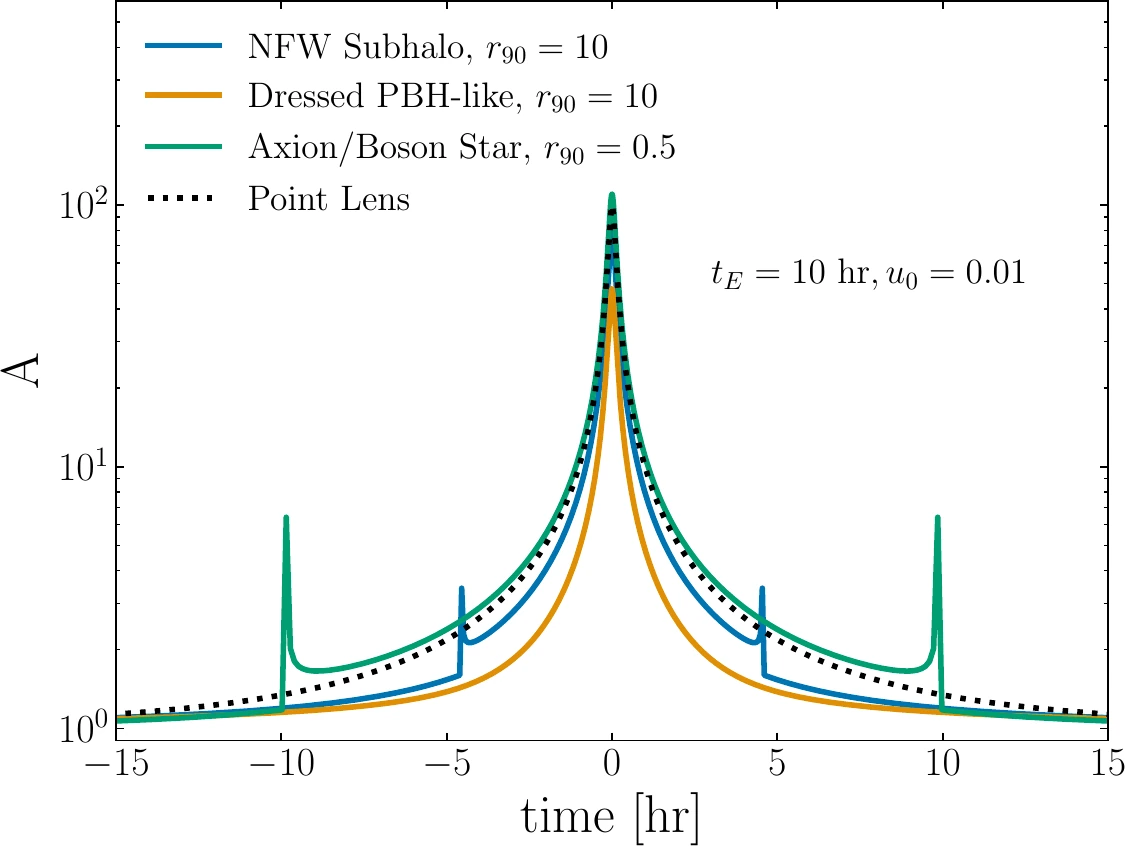
The extra peaks on either side of the main brightness peak come from the way matter is distributed inside the lens. DeRocco, Smyth, and Takhistov, Fig. 1
2024 · Dark matter lenses
Could a clump of dark matter briefly brighten a distant star?
A passing clump of dark matter can bend starlight, and the shape of the brightening depends on how the mass is spread out. We calculated that Roman could detect some types of clumps even if they make up 10,000 times less of the dark matter than earlier searches could probe.
New Light on Dark Extended Lenses with the Roman Space Telescope William DeRocco, Nolan Smyth, and Volodymyr Takhistov The Astrophysical Journal Letters 965, L3 (2024)
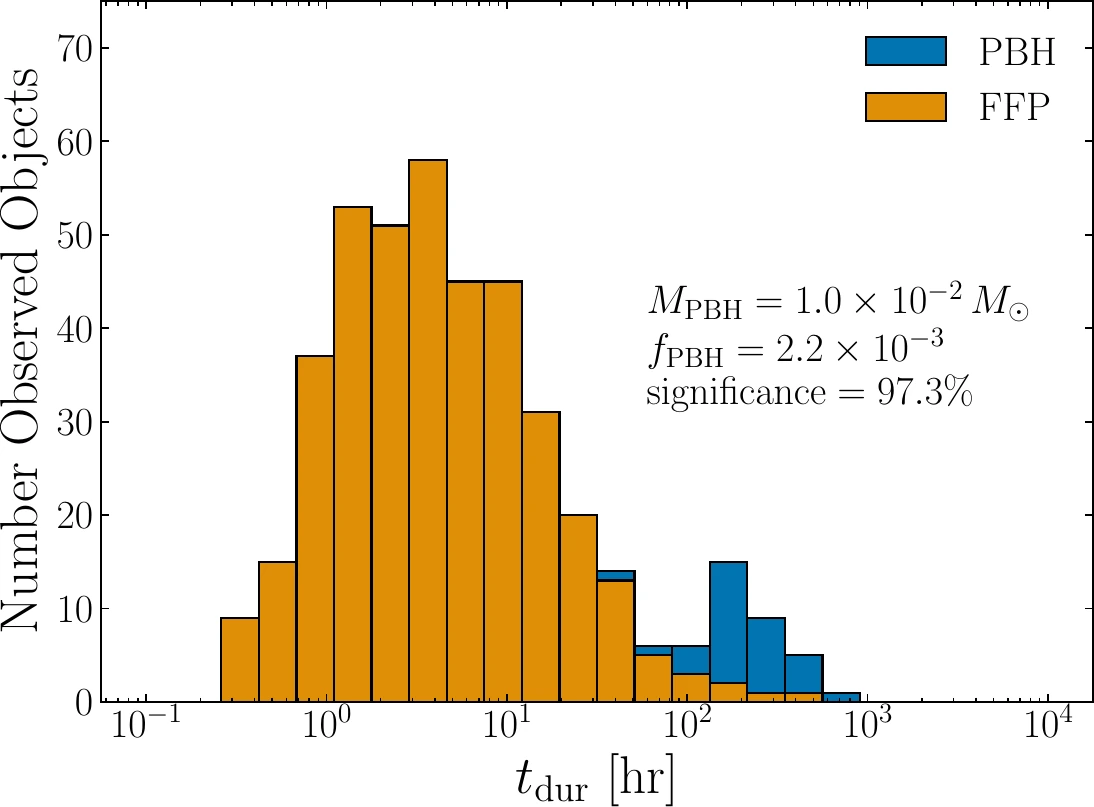
In this simulated survey, black holes add enough longer events to distinguish the combined population from planets alone. DeRocco et al., Fig. 3
2024 · Primordial black holes
Could Roman tell rogue planets from black holes left over from the early universe?
A planet and a black hole of the same mass can produce identical microlensing events. We showed that the distribution of event durations could reveal a population of black holes hiding among the planets, even if those black holes account for as little as one part in 10,000 of the dark matter.
Revealing terrestrial-mass primordial black holes with the Nancy Grace Roman Space Telescope William DeRocco, Evan Frangipane, Nick Hamer, Stefano Profumo, and Nolan Smyth Physical Review D 109, 023013 (2024)
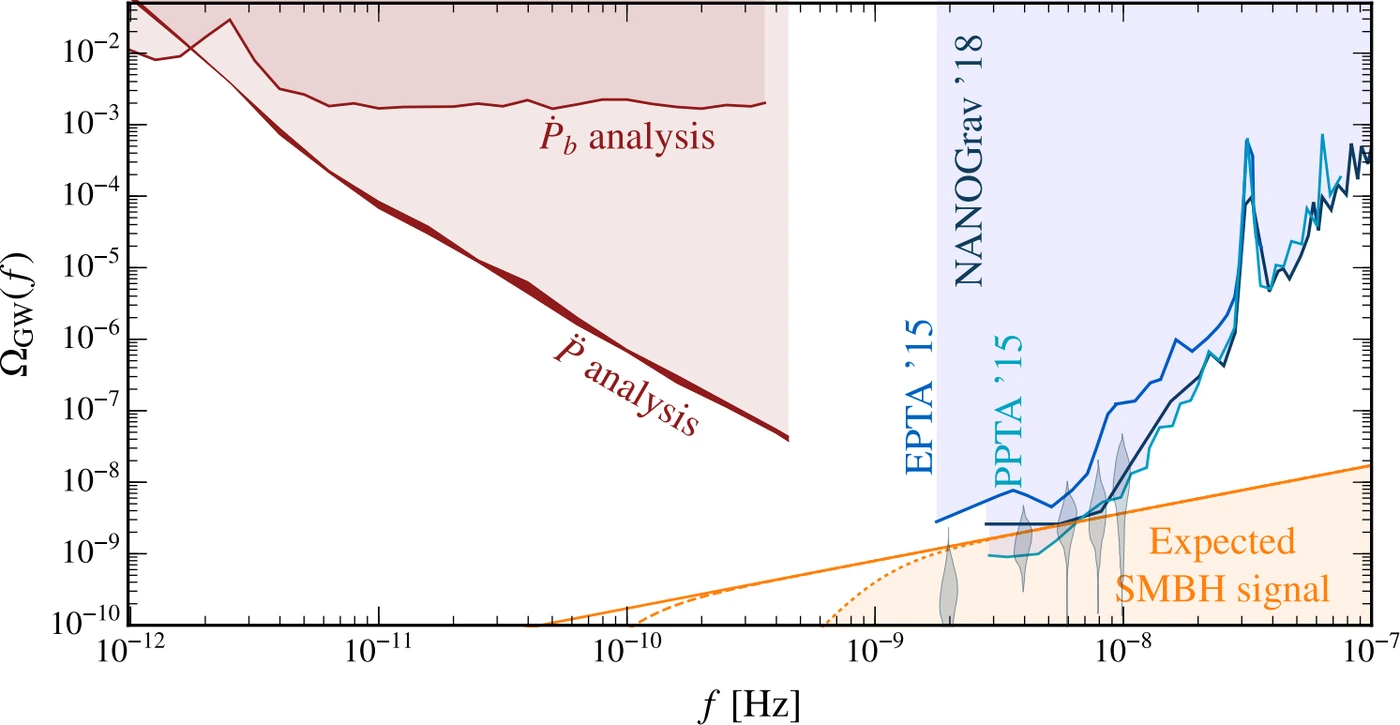
Pulsar spin and orbital measurements constrain the energy in a gravitational-wave background at frequencies below those covered by earlier timing searches. DeRocco & Dror, Fig. 1
2023 · Gravitational waves
Could pulsars pick up a background of very slow gravitational waves?
Many distant sources can combine to produce a background of gravitational waves. We looked for the pattern it would leave in the slowly changing spins and orbits of pulsars across the sky and set a limit on how much energy these long waves carry.
Searching for stochastic gravitational waves below a nanohertz William DeRocco and Jeff A. Dror Physical Review D 108, 103011 (2023)
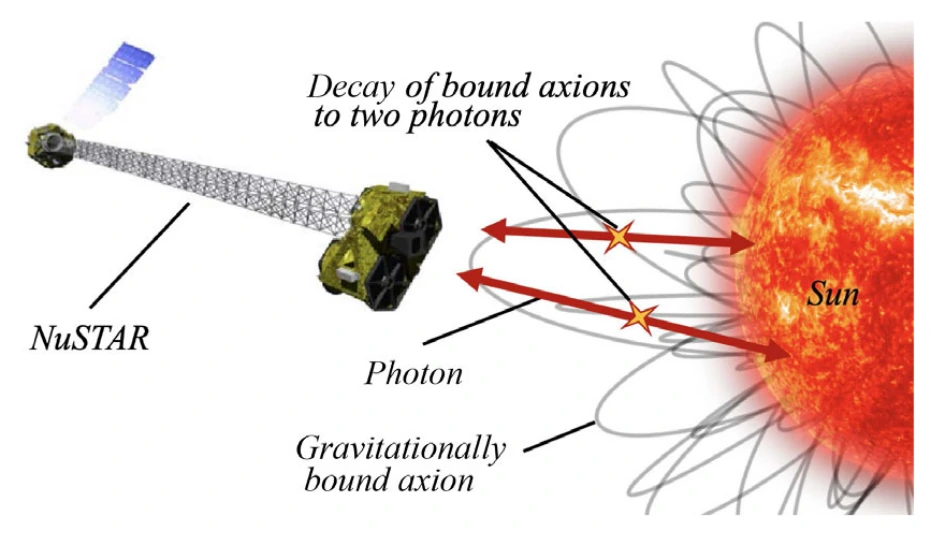
An axion orbiting the Sun could decay into two X-ray photons. NuSTAR looked for this glow near the edge of the solar disk. DeRocco et al., Fig. 1 (CC BY 4.0)
2022 · Solar axions
Could the Sun be surrounded by a cloud of axions?
If the Sun produces axions, a small fraction could travel slowly enough to stay in orbit around it. We searched NuSTAR observations for X-rays from their decay and set tighter limits on how strongly axions in the 5–30 keV mass range could interact with ordinary matter or light.
First Indirect Detection Constraints on Axions in the Solar Basin William DeRocco, Shalma Wegsman, Brian Grefenstette, Junwu Huang, and Ken Van Tilburg Physical Review Letters 129, 101101 (2022)
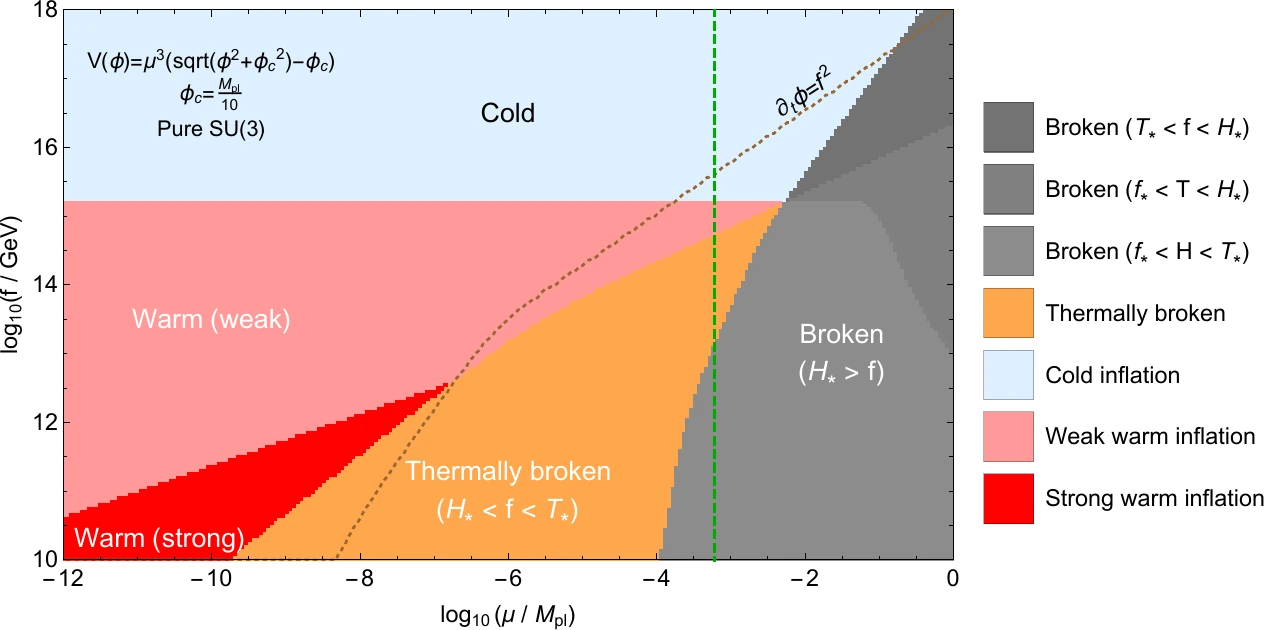
In the red and pink regions, particle production keeps the universe warm as it expands. DeRocco, Graham, and Kalia, Fig. 1
2021 · Early universe
Could the universe have stayed warm during inflation?
The rapid expansion of the early universe tends to dilute any particles present. We showed that if an axion drove that expansion, it could continually produce new particles and maintain a hot bath, changing what those models predict about the early universe.
Warming up cold inflation William DeRocco, Peter W. Graham, and Saarik Kalia Journal of Cosmology and Astroparticle Physics 2021 (11), 011 (2021)
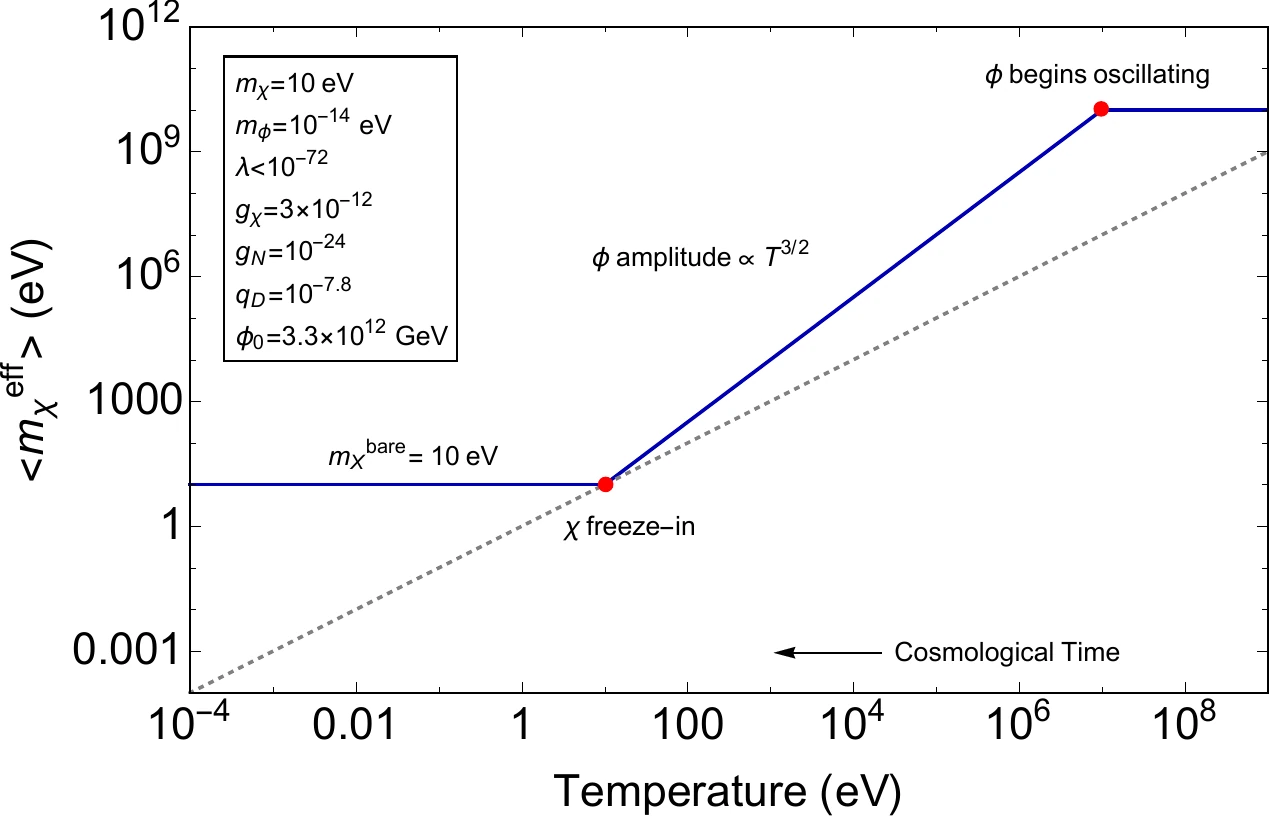
The same model changes the particle’s mass in the early universe. Where the blue curve lies above the dotted line, the thermal bath has trouble producing the particle. DeRocco, Graham, and Rajendran, Fig. 1
2020 · Stellar cooling
Could a light particle escape the limits set by cooling stars?
Stars would cool faster if they could shed energy by emitting new particles. We built a model in which a particle becomes so heavy inside a dense star that the star can hardly produce it, even though a laboratory on Earth could still make it.
Exploring the robustness of stellar cooling constraints on light particles William DeRocco, Peter W. Graham, and Surjeet Rajendran Physical Review D 102, 075015 (2020)
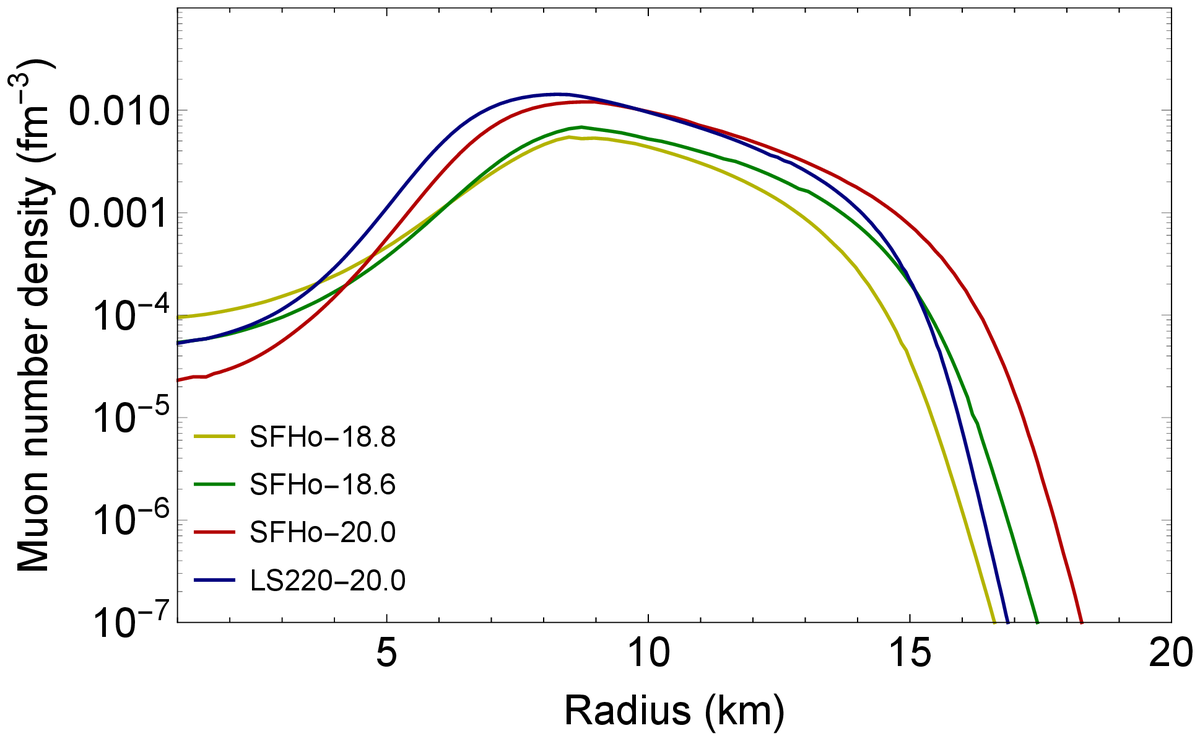
Where the muons are, one second after the core bounces. Each curve comes from a different supernova simulation. Bollig et al., Fig. 3
2020 · Axions
What can a dying star tell us about axions?
The collapsing core of a massive star makes muons, heavy cousins of electrons. If muons produced enough axions, these hypothetical particles would carry heat away from the star. We used the duration of the neutrino signal from Supernova 1987A to limit how strongly axions could interact with muons.
Muons in Supernovae: Implications for the Axion-Muon Coupling Robert Bollig, William DeRocco, Peter W. Graham, and Hans-Thomas Janka Physical Review Letters 125, 051104 (2020)
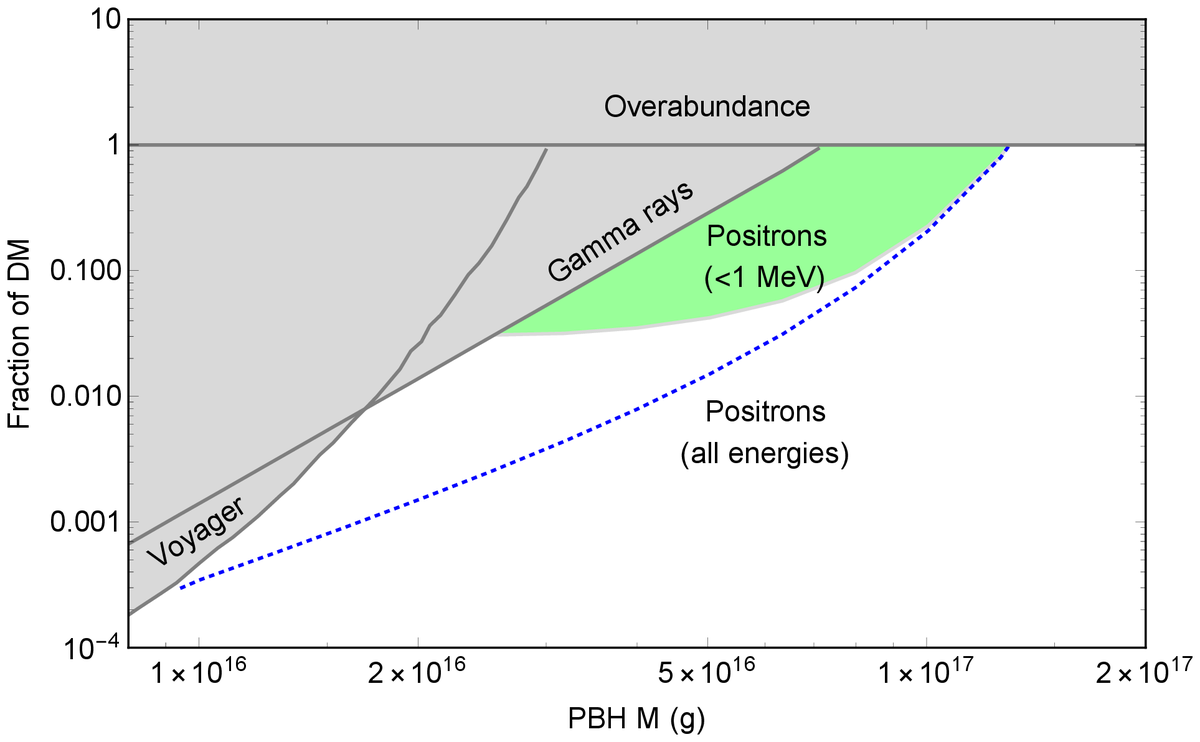
In the green region, a population of black holes of a single mass would produce more positrons than the observed glow allows. DeRocco and Graham, Fig. 1
2019 · Primordial black holes
Could tiny black holes account for the Milky Way’s dark matter?
Small black holes left over from the early universe should emit positrons as they evaporate. When those positrons meet electrons, they produce gamma rays at a known energy. We used the measured brightness of this glow to rule out black holes in part of the asteroid mass range as the sole source of dark matter.
Constraining Primordial Black Hole Abundance with the Galactic 511 keV Line William DeRocco and Peter W. Graham Physical Review Letters 123, 251102 (2019)
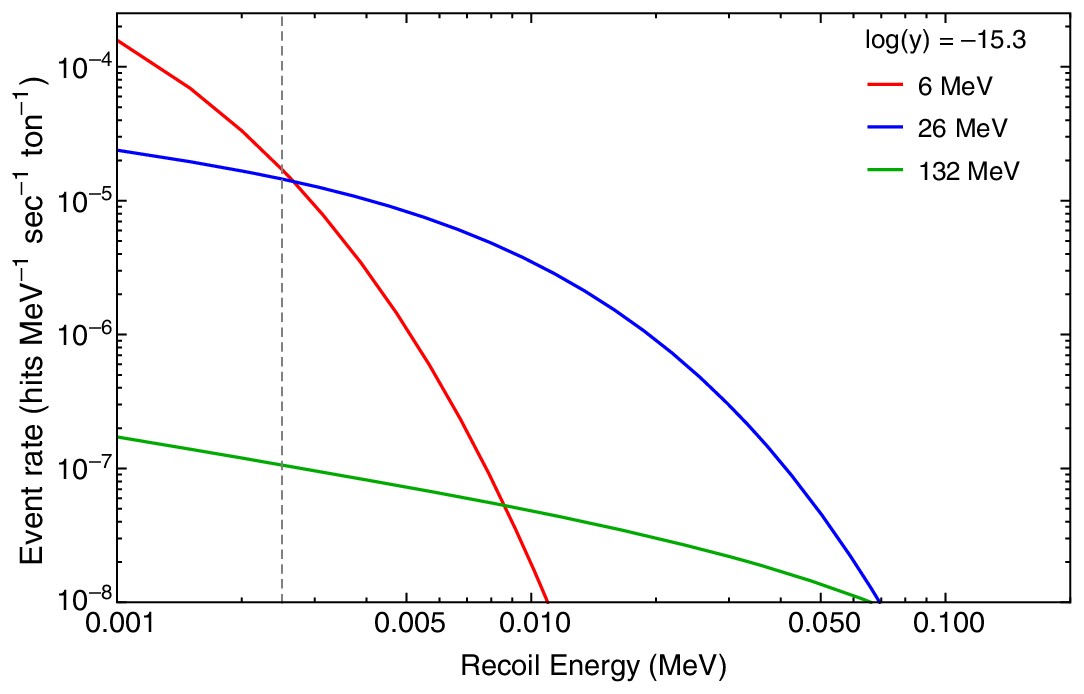
For three possible dark matter masses, the model predicts some collisions energetic enough to cross a xenon detector’s threshold (dashed line). DeRocco et al., Fig. 5
2019 · Dark matter detection
Could a supernova make light dark matter visible on Earth?
Light dark matter drifting through the Galaxy can barely move an atom in a detector. We found that dark matter born in the heat of a collapsing star could arrive at Earth fast enough to give a xenon nucleus a measurable kick.
Supernova signals of light dark matter William DeRocco, Peter W. Graham, Daniel Kasen, Gustavo Marques-Tavares, and Surjeet Rajendran Physical Review D 100, 075018 (2019)
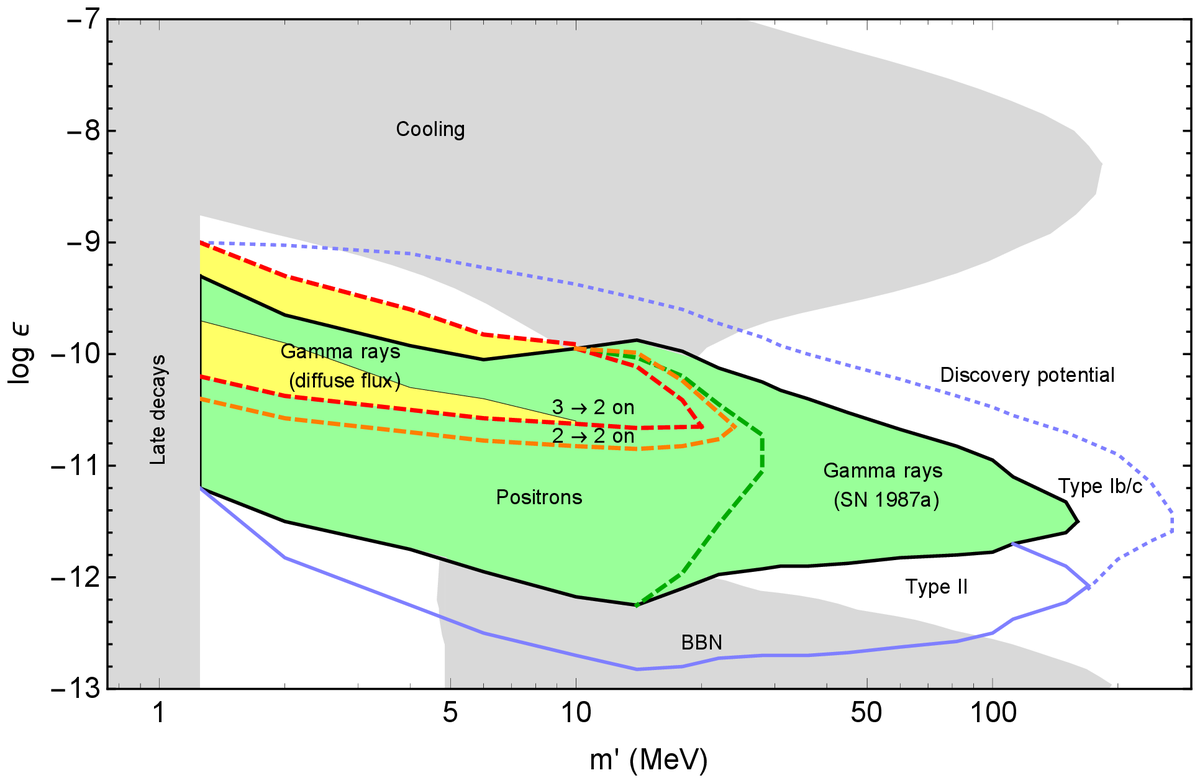
The green region shows which combinations of dark photon mass and interaction strength the observed light rules out. The blue contours show what a future Milky Way supernova could reveal. DeRocco et al., Fig. 1
2019 · Dark photons
What would a supernova look like if it emitted dark photons?
A hypothetical dark photon could escape an exploding star and decay outside it. We found that the gamma rays from these decays and the glow left by their positrons could reveal dark photons even when they have little effect on how fast the star cools.
Observable signatures of dark photons from supernovae William DeRocco, Peter W. Graham, Daniel Kasen, Gustavo Marques-Tavares, and Surjeet Rajendran Journal of High Energy Physics 2019 (02), 171 (2019)
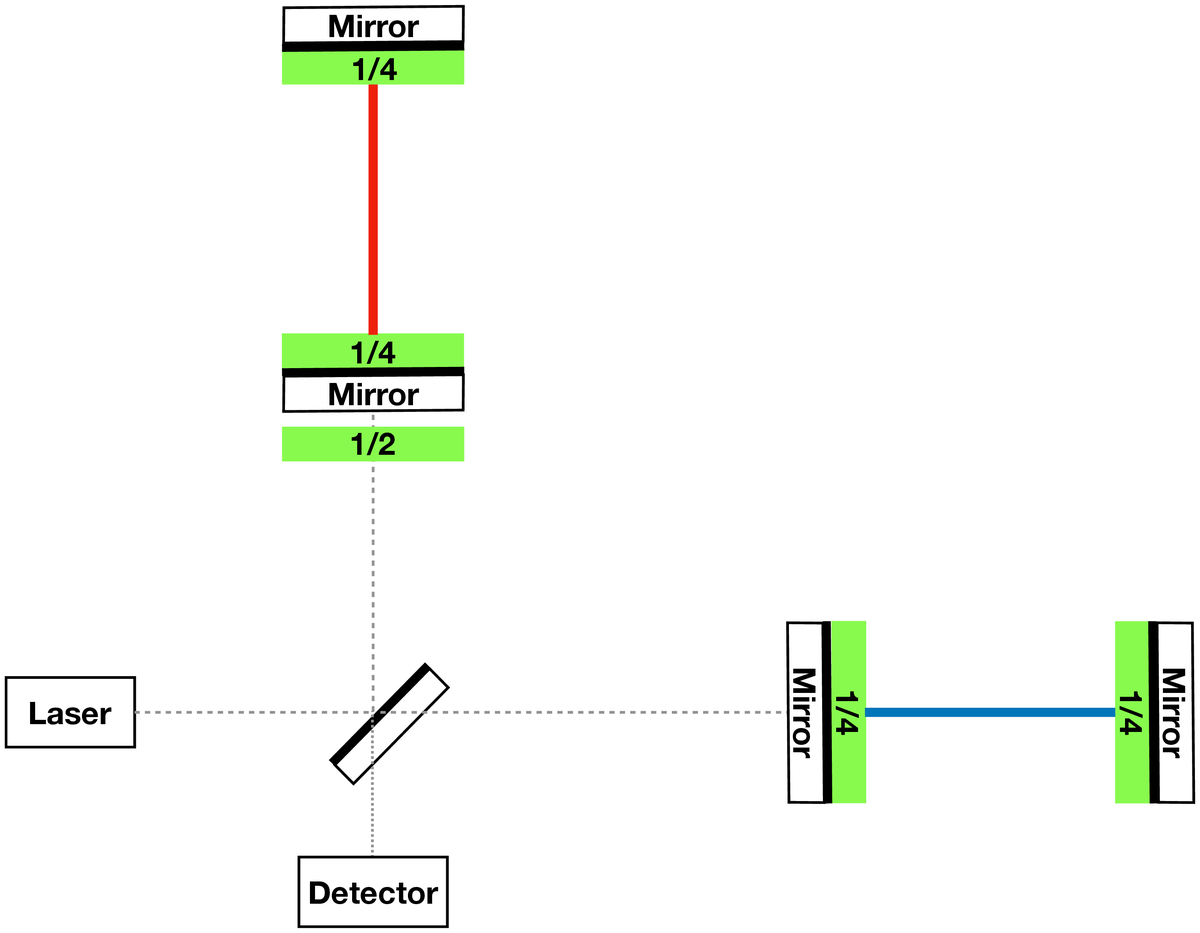
A beam splitter sends light down two arms. Recombining the beams at the detector would reveal a relative shift in their phases. DeRocco and Hook, Fig. 2
2018 · Axions
Could axions change the timing of laser light?
Axion dark matter could shift the timing of two light waves whose electric fields rotate in opposite directions. We designed an interferometer that compares those waves and calculated how small a shift it could detect.
Axion interferometry William DeRocco and Anson Hook Physical Review D 98, 035021 (2018)
 William DeRocco