William DeRocco
Teaching
At Stanford, I was a teaching assistant for courses ranging from introductory physics to graduate general relativity. Drawing on that experience, I created an undergraduate general relativity course at the University of Maryland and taught it two winters in a row.
An Introduction to General Relativity
PHYS499G · University of Maryland
January 2025 and January 2026 · 1 credit
This three-week course is for upper-level undergraduates who know multivariable calculus and basic mechanics. Starting from Newtonian kinematics and gravitation, we build up to the Einstein and geodesic equations through interactive lectures and exercises.
What’s the longest word you can make from capital letters that are one-manifolds?
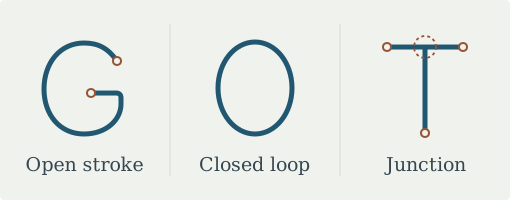
Imagine drawing each capital letter as a thin stroke. Smooth out any cusps, like the bend in G, and leave out the endpoints of open strokes. Which letters can you use?
A hint
Zoom in on any point of the letter. A small neighborhood should look like an open interval. That works all the way around an O. Try the same test where the three arms of a T meet.
See my word from class
I came up with COLUMNS. Can you beat seven letters?
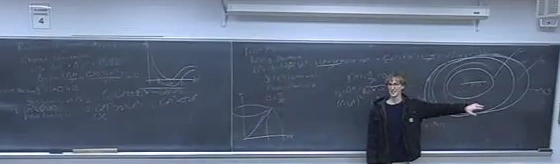
Students teach the last class
For the final exam, each student chooses a spacetime, works out what its metric tells us, and gives a thirty-minute chalk talk on it to the class. Previous years have included gravitational wave metrics, rotating black holes, warp drives, expanding universes, and more.